
House of Horrors, Part 1


The House That Was Always Watching
Content warning: this story discusses violence against women, addiction, exploitation, and disappearance.
By Mark DeLuca, Executive Director, The Find Me Project
For seven months, a photograph of a missing woman sat on the homepage of a public website. A black eye. A bloodied lip. Her name, had anyone looked, was already logged in a federal database of the missing. It stayed up anyway.
This is the story of the house that photograph came from and the question that should outlast every headline it generates: how many chances did the system have to find it first?
I. The Traffic Stop
It started, as so many of these cases do, with something small.
On June 19th, 2026, a U.S. Park Police ranger near Philadelphia's Independence Mall approached a black BMW parked illegally in a space reserved for law enforcement. Behind the wheel was a 44-year-old man named Eugene Horsch. Beside him, a woman.

She handed over an identification card. The name on it was Blair Tonzelli.
A search of the vehicle turned up a counterfeit federal DEA badge bearing Horsch's photograph under a different name, along with cocaine, fentanyl, marijuana, and two firearms. Eugene Horsch was arrested that day. In July, a federal grand jury indicted him for being a felon in possession of a firearm, and for producing fraudulent federal identification. Nothing more. He has been held since on $500,000 bail at Curran-Fromhold Correctional Facility.
I want to say that plainly, because it matters for everything that follows: those are the charges. Gun charges. Fraud charges. What happened next, what the ID card in that woman's hand turned out to mean is a different story entirely, and as of this writing, no one has been charged in it.
II. The Card That Wasn't Hers
Here's where the case stops being a traffic stop and starts being something else.

Blair Tonzelli was a real person and she had already been missing for three years. Her friends reported her disappearance to Philadelphia police in February 2023, telling officers she'd last been seen the previous summer at a house in the city's Olney neighborhood. The report went into the system. It generated no headlines, no broadcasts, no public appeal. It became one more file in the National Missing and Unidentified Persons System, alongside tens of thousands of others.
Seven months later, in September 2023, a photograph of Tonzelli appeared prominently on a public adult website run by a man named Raymond "R.C." Horsch. In the image, archived web records reviewed by the Philadelphia Inquirer show, she has a black eye and a bloodied lip.
Police have not said whether officers ever visited the Olney property or interviewed Horsch after Tonzelli was reported missing, or whether they were aware her photograph was live on his public website for months afterward.
That's not a detail I'm including for atmosphere. It's the center of the story. The address, the name, the photograph, pieces of this were sitting in public and quasi-public records for three years before a park ranger's parking complaint connected them. We don't yet know why. That question deserves its own chapter of this investigation, and we intend to keep asking it.
It wasn't even the system's only missed opportunity. Reporting has since surfaced that narcotics detectives searched the same property in May 2025, more than a year before Eugene Horsch's arrest, after a fire at the home turned up marijuana plants, firearms, ammunition, and unidentified chemicals. According to the Inquirer, the police report from that search made no mention of missing women. Friends and relatives of at least one missing woman reportedly directed authorities to the property in prior years as well. The house was visible. The file existed. The dots went unconnected for reasons that still aren't public.
III. The House on Chew Avenue
To understand what investigators eventually found inside 417 West Chew Avenue, you have to understand who had been living there, and for how long. Property records show the home previously belonged to Helen Hoersch, an aunt of

Raymond Horsch, who died inside it in 2004 at age 83. In 2007, Raymond, using power of attorney for his late aunt, transferred the deed to his son, Eugene, for a disclosed $40,114. Raymond lived there until his own death in May 2025, at 82. He was never charged with any crime connected to a disappearance.
What police found when they finally searched the property in June 2026 didn't resolve the case. It multiplied it: chemicals, a 55-gallon drum, plastic storage containers, zip ties, a note referencing the serial killer Ted Bundy and hard drives holding more than a million digital images and video files.
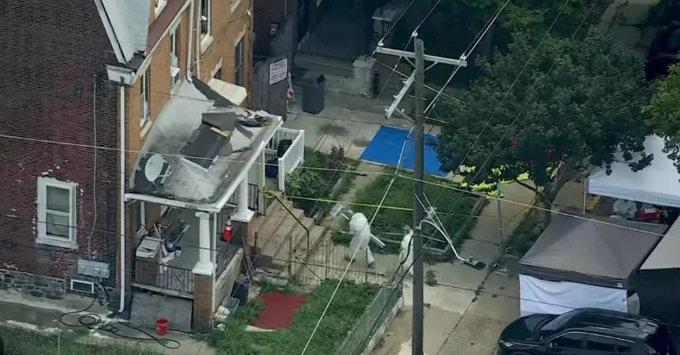
In August, state charges tied to the search were withdrawn as federal prosecutors formally assumed jurisdiction over the investigation. A million files is not a number a department works through in a week. It's not a number it works through in a month. Somewhere inside it, investigators would eventually find the first hard evidence connecting this house to a name that had been sitting, unresolved, in a missing-persons database for eight years.
IV. The Man Who Called Himself a Villain
Raymond Horsch was not a private man. He built a public identity around being provocative, decades of self-published adult films, erotic photography, and novels, alongside a documented criminal history of forgery and drug manufacturing. In a 2013 interview with a podcast called the Rialto Report, he spoke at length, and by his own choice, about leaning into a dark persona, his words, which I'm paraphrasing rather than repeating in full, because his own writing gets considerably more disturbing from there.
CBS News Philadelphia reviewed hundreds of pages of Horsch's self-published books, including a 2014 title called Empathy

. Its own promotional description frames it as an autobiographical account, his framing, not a court's, of a character he called a "caring, empathetic serial killer." In one chapter, according to CBS Philadelphia's review, Horsch claims to have killed a woman and describes disposing of a body through a chemical process. No court has ever tested that claim. He was never charged with homicide, in his lifetime or after.
I want to slow down here, because this is the line that separates responsible reporting from exactly the kind of content Horsch spent a career profiting from: a man's own writing about himself is not evidence. It's a data point. Self-mythologizing killers are a documented phenomenon. So are con men who invent a monster persona because it sells books. Investigators don't get to assume which one they're looking at. Neither do we. What moved this from a disturbing old paperback to an active federal case wasn't the book. It was what came out of that house after June 19th, 2026.
V. What Was Already in the File
It would be easy to end this story at the house. I'm not going to, because the house isn't really where it starts. Blair Tonzelli's case sat untouched in a database for three years. A photograph of her, visibly injured, sat on a public website for at least seven months of that window, apparently without drawing law enforcement attention. A narcotics search of the same property in 2025 came and went without anyone flagging a connection to a missing woman. Friends and relatives, by multiple accounts, had already pointed authorities toward this address before any of this became a federal case.
None of that is a story about one bad cop or one overlooked tip. It's a story about how many separate, ordinary points of contact a missing-persons report, a public website, a narcotics warrant, a family's own repeated attempts to be heard can each individually fail to connect, until a parking violation outside Independence Mall does the connecting instead. That gap is the one The Find Me Project exists to close. Not after the fact. Before it.
VI. The Seven

As this investigation has widened, the number of women connected to that house has grown. At the time of Eugene Horsch's arrest, investigators were examining ties to four names. That number has since grown to seven, five of whom police now say they believe are dead. None of their remains have been recovered.
We're treating each of their stories with the depth they deserve, not as a list, and not as a body count, in the next installment of this series. What we can say plainly here is this: Blair Tonzelli's disappearance was reported. It was logged. It was, in a real and documented sense, known to the system for three years before anyone acted on it. She is not an edge case in this story. She may be its clearest illustration.
VII. What We Owe Them
I've spent years now studying the space between "missing" and "found", the paperwork gaps, the jurisdictional seams, the quiet place where a case can sit, fully documented and entirely unresolved, for as long as nobody happens to connect it. Blair Tonzelli's file didn't vanish. It just didn't move.
That's the problem The Find Me Project was built to address, not with more headlines after the fact, but with the search infrastructure, intelligence work, and sustained attention that a case needs before a parking violation becomes the thing that finally connects the dots. Diane Fusaro, whose daughter Nicole's story we'll tell in full in our next episode, searched the streets of Kensington for six years on her own, with none of that infrastructure behind her. She died in 2020, still looking.
If you have information about any missing person, in Philadelphia or anywhere else, the National Missing and Unidentified Persons System takes public tips directly, and so does the Philadelphia Police Department.
House of Horrors, Part 1, is available now. Episode 2, a full accounting of the seven women connected to this case, and the history of the man whose house connects them, follows shortly.


Comments